
Your title deed can carry conditions that limit what you may do with your land, and they can stop a plan the council has already approved.
What they look like
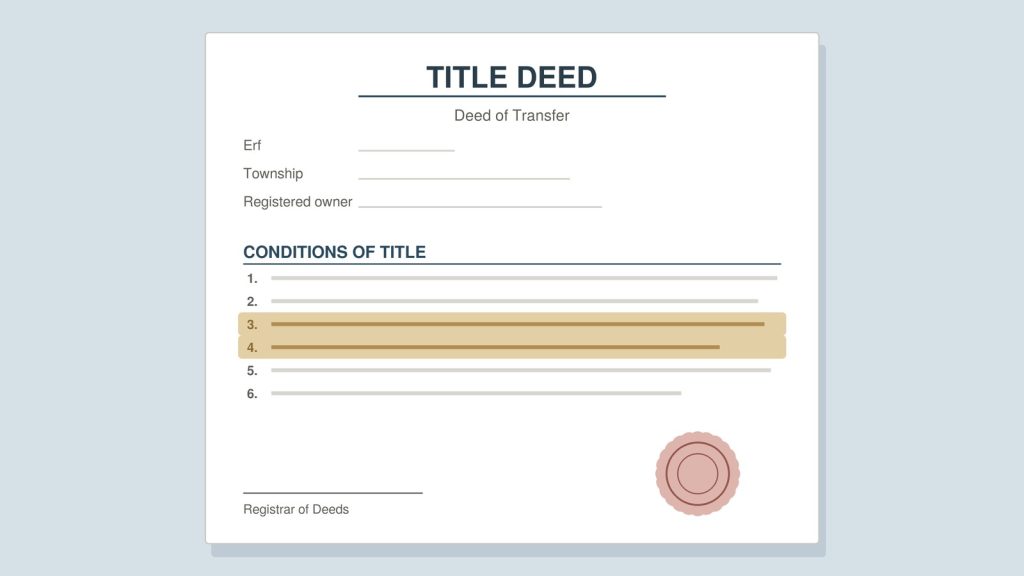
Restrictive conditions are registered against the property and bind every owner after you. Common ones limit subdividing the land, the number of dwellings, the height or number of storeys, and how close to a boundary you may build. They are separate from the zoning scheme, and the two can overlap.
Which one wins
Restrictive title deed conditions take precedence over municipal approval. A council approval does not authorise building that conflicts with a condition in the deed, so both have to be met.
How to read your deed
- Get a copy. From the seller, from your conveyancing attorney, or as an information copy from the Deeds Office.
- Read the exact wording. What a condition allows, and who it protects, depends on how it is written.
- Read the servitudes too. They are registered in the deed and bind later owners.
We read the wording before anything is drawn.
Can a condition be changed?
It depends on the wording:
- Some conditions can be relaxed.
- Some cannot be relaxed at all, and have to be amended or removed. That is done as a planning application to the municipality under the Spatial Planning and Land Use Management Act (SPLUMA) and the municipality’s by-law.
- Some cannot be removed. For example, a condition in favour of a nature conservation body, or one that benefits other land, is protected under some municipal by-laws.
How it works
- Read. We read the deed and the scheme, and work out which route applies.
- Apply. We prepare the application and a motivation for the municipality.
- Notice. Affected neighbours and anyone the condition protects are notified, and can comment or object.
- Decision. The municipality decides. Its approval has to come before anything is registered.
- Registration. Your attorney (the conveyancer) lodges the amendment at the Deeds Office.
Some owners go to the High Court instead. It is a different route, and it is usually slower and more expensive.
A real example
On a major renovation on the South Coast, we obtained a building line relaxation and an amendment to the title deed, both approved, and then submitted deviation plans. See Southbroom House K. For the building line side, read building line relaxation.
Further reading
Where we have relied on outside sources, here they are, so you can read them yourself.
- Spatial Planning and Land Use Management Act 16 of 2013 (gov.za)
- What property owners should know about restrictive title deed conditions vs municipal approval (Cliffe Dekker Hofmeyr)
- Restrictive property conditions (STBB)
- Watch out for restrictions on your property (Property24)
- Municipal Spatial Planning and Land Use Management By-law (example, Alfred Duma Municipality, KwaZulu-Natal) (Provincial Gazette 1797, 2017)
This is general information, not legal advice. Rules differ between municipalities, so check yours or speak to us.
Speak with a registered professional.
Send us the erf number and what you want to do.